



“Eating independently despite severe paralysis of the arms”
Background
People with ALS often lose the ability to bring food to their mouths independently due to progressive paralysis. This not only leads to an increase in dependence on other people but can also significantly shorten their lifespan. For many people, being handed food, or “being fed”, is associated with a considerable loss of dignity and therefore reduces the satisfying nature of eating. The result is a reduction in the amount of food eaten and additional weight loss, which can significantly limit lifespan as an “independent mortality factor”. In addition, the social aspect of eating together is often disrupted by the provision of food, meaning that carers can also be exposed to a high level of stress. Visits to restaurants or meals with friends are then often discontinued.
Function and structure
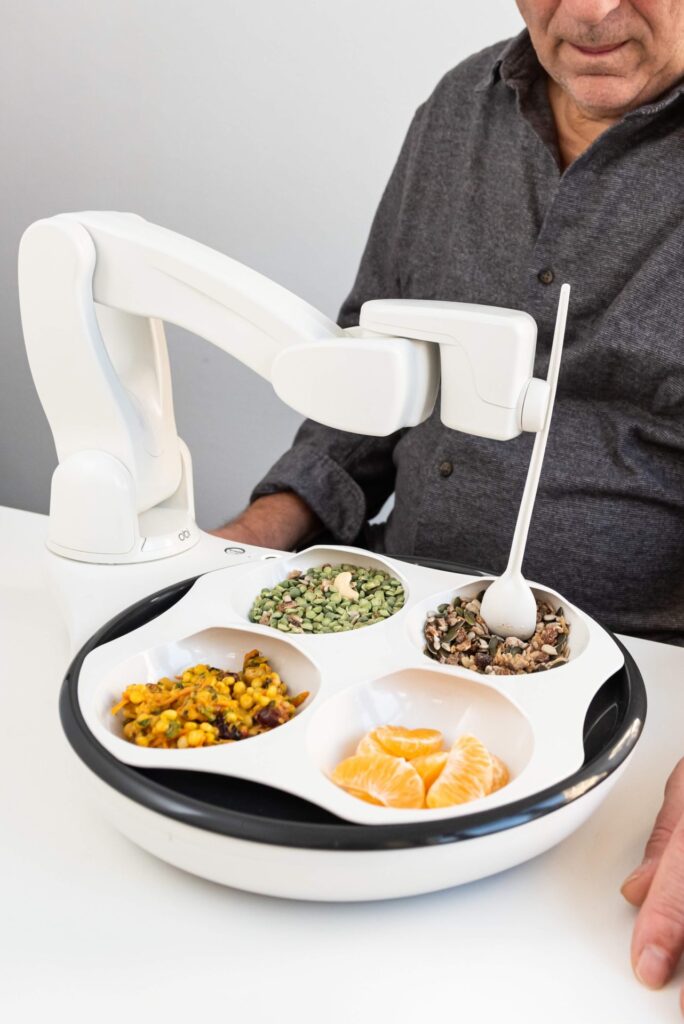
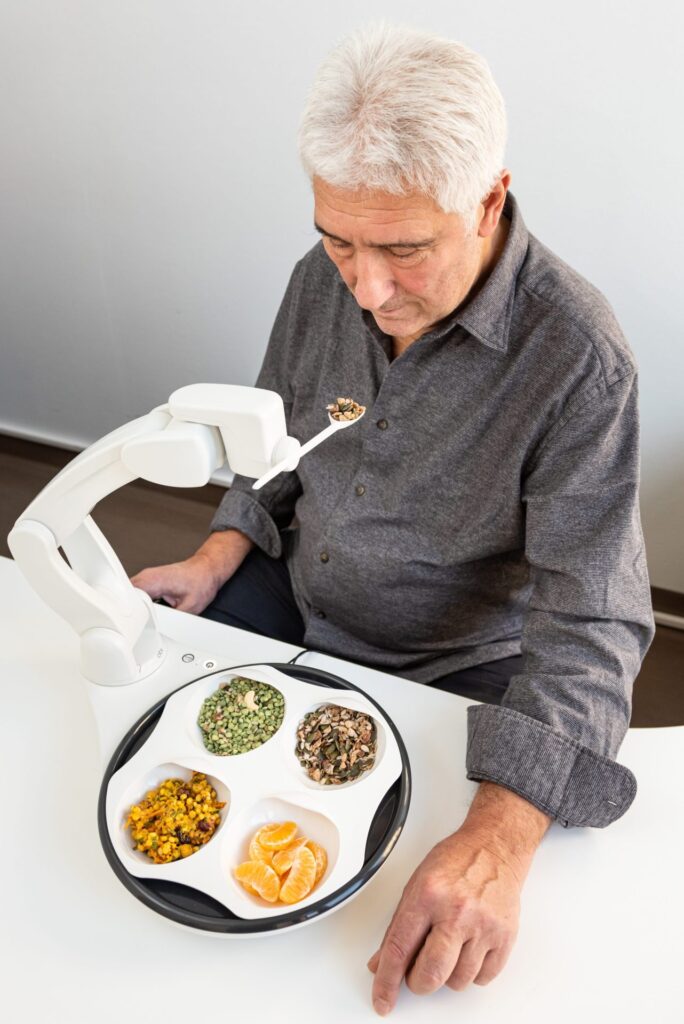
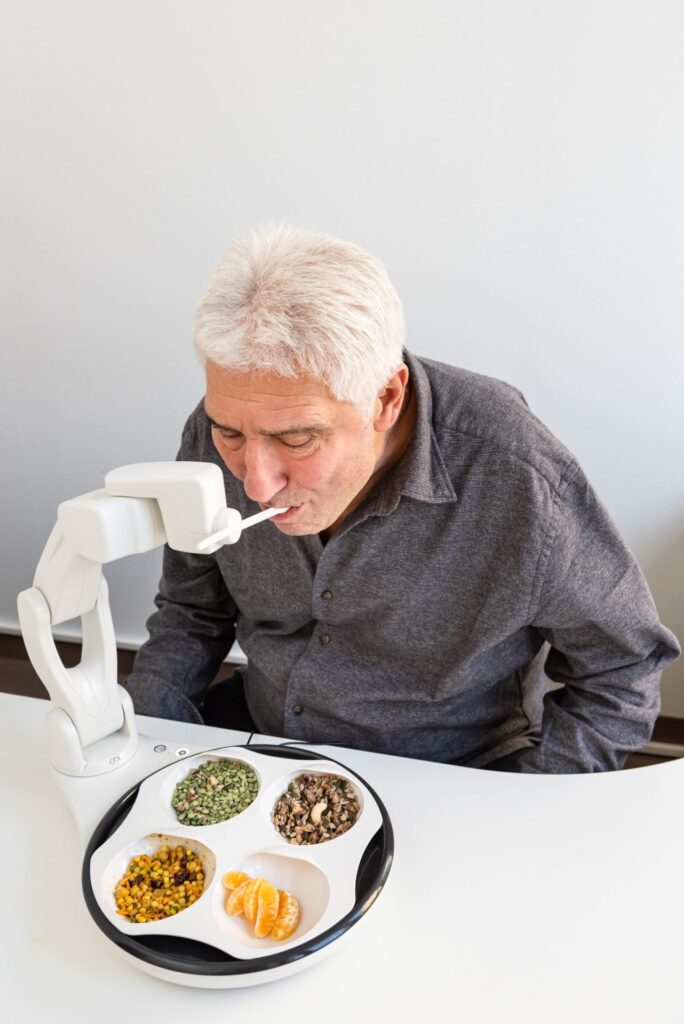
The eating robot is a movable plastic arm that guides a spoon between a plate and the patient’s mouth at the patient’s “command”. In this way, a meal can be consumed without the need for a third party to pass the food. The meal is served in a special plate. The plate has several bowls in which the meal is portioned.
The eating aid takes up very little space on the dining table. It consists of a serving unit with four bowls for the individual components of the meal and the robotic arm, which picks up the food one bite at a time with a spoon and guides it to your mouth. You alone decide at what speed you eat which dish by directing the robotic arm with a sensor.
Operation and switches
Once the “delivery location” of the spoon and the robotic arm has been determined, you can use two microswitches (one to select the food and one to control the food delivery) to guide the robotic arm to the desired bowl of the plate, slide the food onto the spoon and guide the spoon to the mouth. Certain elements of the movement (e.g., loading the food onto the spoon, wiping the spoon and repositioning the food) are “automatic”.
The switch connections are 3.5 mm jack plugs (headphone connection), making the Obi compatible with a wide range of switches and sensors on the market
It is possible to customise the control module to your individual needs and possibilities. (fingers, headrest, etc.)
Product advantages
- Customizable: New movements and positions can be customized in seconds.
- Safe: Collision detection.
- Modern: Unobtrusive design, quiet and unobtrusive operation, smooth movements.
- Intuitive: two control buttons set the rhythm and select different dishes from four bowls.
- Easy to clean: Disinfectant wipe or a damp cloth can be used to clean the arm and base, spoon, plate and placemat are dishwasher safe.
- Mobile use: thanks to an integrated rechargeable battery (operating time approx. 3 hours) and the light weight (approx. 3 kg), meals can also be taken away from home.
- Cost coverage: Costs can be covered by health insurance based on a doctor’s prescription and a trial by specialised providers.
Social participation
The simple handling supports the intake of sufficient quantities of food. The appliance also allows you to have additional snacks provided for in-between meals. You can enjoy these whenever you feel like it – regardless of whether there is another person in the room with you who could serve the snacks or not.
With the meal robot, eating becomes a pleasant and self-determined experience. The ability to eat together with family members, for example, contributes to a relaxed dining atmosphere and social interaction during mealtimes.
Prerequisites
Users of an eating robot may have the following conditions:
- Amyotrophic lateral sclerosis (ALS)
- Amputations
- Cerebral palsy
- Essential tremor
- Multiple sclerosis
- Muscular dystrophy
- Parkinson’s disease
- Spinal cord injury
- Other diseases that affect the motor function of the upper extremities
Users must be able to operate the eating robot safely. They must also be able to chew and swallow without assistance. It is the caregiver’s responsibility to monitor the user adequately while using the robot. Observe the following criteria when providing care:
- Cognitive skills to operate a simple machine
- Decisions about the selection and consumption of food can be made independently.
- The user can chew and swallow without assistance.
Information material about meal robots for download

Operating instructions
Meal robot user manual
The user manual contains information on the intended use and how to ensure safe and successful interaction with a meal robot.
Ambulanzpartner Soziotechnologie APST GmbH
Westhafenstraße 1
13353 Berlin