




Background
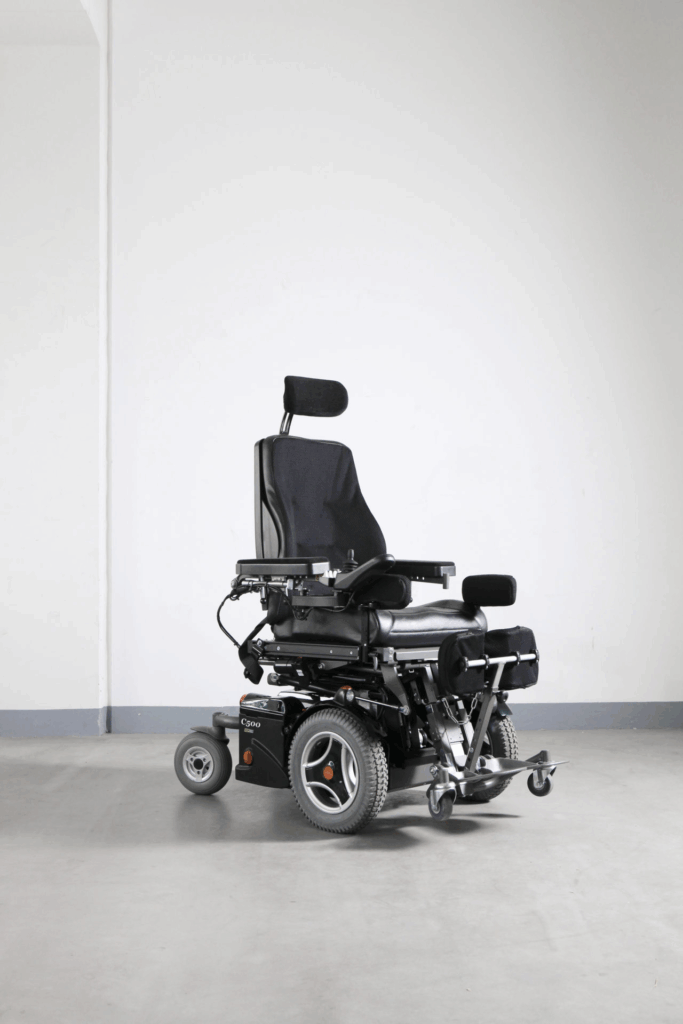
The power wheelchair is an important aid for maintaining mobility when walking distances are shortened, walking speed is reduced, or walking is no longer possible. The term “electric” refers to the built-in motors that allow the wheelchair to be driven, the backrest to be adjusted, and the seat height to be changed. The integration of electric motors makes it possible to drive both indoors and outdoors. In addition to driving, the independent adjustment of the body position (“positioning”) plays a decisive and often underestimated role in ALS. Complex power wheelchairs are used for ALS, which allow electric adjustment of the backrest, headrest, armrests, seat height and leg position. Certain power wheelchairs also have an integrated lifting and standing function. This means that the height of this seat can be changed independently and repeated standing (with all the associated physical and psychological benefits) can be achieved. The provision of an appropriate power wheelchair is a core element of gradual and adapted care for people with ALS who have progressive limitations in leg and trunk functions.
Function and structure
A distinction is generally made between indoor and outdoor wheelchairs. “Indoor” is the English term for “inside”. The name of the power wheelchair already indicates that it is a power wheelchair that has been optimised for indoor use (inside the apartment or house). These indoor power wheelchairs are particularly compact and are configured with a narrow width. This allows them to pass through most doors and passageways. Another feature is the manoeuvrability of the wheelchair (by configuring the wheel control), so that turning on the spot (e.g., for narrow kitchens and other confined living spaces) is possible. Despite their small dimensions and manoeuvrability, the indoor power wheelchairs are equipped with a seat tilt (electric adjustment of the backrest tilt), lift function (independent control of the seat height) and standing function (hydraulics for repeated standing during the day). Indoor wheelchairs are suitable for people with ALS who are looking for complete autonomy in positioning and changing their body position, and for whom outdoor activity in a power wheelchair is not a priority. It should be emphasised that indoor wheelchairs can also be used outdoors and are also fully functional on the road. The main limitations of indoor wheelchairs for outdoor use is the reduced battery power and the reduced range of action. Certain driving characteristics on uneven terrain are also limitations for indoor wheelchairs. In this case, outdoor wheelchairs are preferable.
Operation and switches
A “conventional” power wheelchair is optimised for driving. The sole function of driving is not sufficient for people with ALS (due to the frequent impairment of the trunk, head support and arm function). In addition to the function of driving, other functions are necessary, which are referred to as “special functions”. In the context of ALS, the term “special function” is misleading, as these functions are not a special feature, but are part of standard care. Special functions in power wheelchairs include an electric seat tilt (adjustment of the backrest up to the reclining function), the lifting function (electric adjustment of the seat height) and the standing function (the patient can be brought into a standing position by means of a hydraulic system even if it is no longer possible to stand up on their own). These special functions must be considered when supplying power wheelchairs.
The difference between a folding wheelchair and a power wheelchair
Wheelchairs are very different and can take on different functions. Two categories of wheelchairs are used for ALS: Folding wheelchairs (push wheelchairs) and power wheelchairs. In most cases, it makes sense to use both wheelchairs at the same time. Folding wheelchairs are used to take the wheelchair with you in your own car or on public transport. They are used for “passive” transfers in which the person concerned is pushed by another person. In contrast, a power wheelchair enables independent movement with an electric motor (instead of a person pushing the wheelchair). However, power wheelchairs are very heavy and cannot be folded. It is not possible to take them with you in a regular car. Due to the different areas of use and transportation capabilities, both wheelchairs are justified and should generally be used in parallel. Experience has shown that it is possible to argue this to the cost bearer.
Prerequisites
Users of a power wheelchair may have the following conditions:
- Amyotrophic lateral sclerosis (ALS)
- Leg amputations
- Stroke
- Essential tremor
- Multiple sclerosis
- Muscular dystrophy
- Parkinson’s disease
- Spinal cord injury
- Other diseases that affect the motor function of the upper extremities
Users must be able to operate the power wheelchair safely. They must also be able to chew and swallow without assistance. Observe the following criteria when providing care:
- Cognitive skills to operate a power wheelchair in road traffic
- Decisions about how to use the device in everyday life can be made independently.
- The user can accommodate the power wheelchair in their living environment.
Social participation
Power wheelchairs for mobility are to be regarded as assistance technology. Certain power wheelchairs with special functions (lifting, reclining and standing functions as well as seat tilting) assist the patient in adopting an optimal (and changing) body position without the need for assistance from another person. Technological progress in the field of electromobility has led to a significant further development of power wheelchairs and the possibilities for compensating for deficits. Power wheelchairs thus preserve and improve patient autonomy and self-determination.