



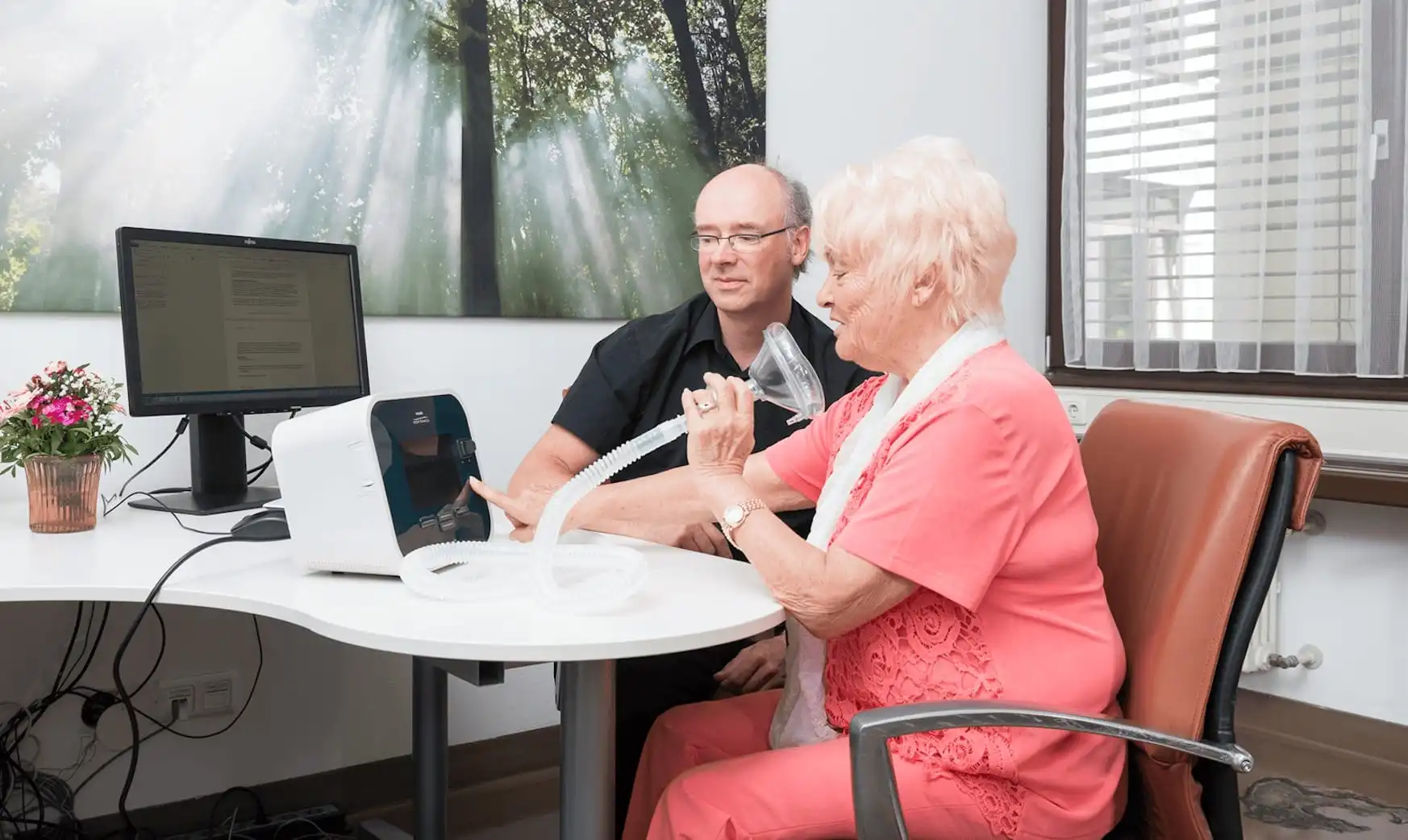
In January 2018, the international journal Amyotrophic Lateral Sclerosis and Frontotemporal Degeneration published the results of a care management program for assistive devices in amyotrophic lateral sclerosis (ALS) via the Ambulanzpartner internet platform.
The provision of assistive devices is of central importance in ALS. Despite its socio-medical relevance, the provision of assistive devices in ALS has not yet been systematically investigated. The following questions are addressed in the current publication:
- What is the supply rate, i.e. the proportion of medical aids actually supplied compared to the medically indicated medical aids?
- How high is the rejection rate of the various aids by patients themselves and the payers?
- How long is the supply latency from the medical indication to the delivery of an assistive device by the supplier?
The provision of medical aids at 12 leading German ALS centers was evaluated over a period of 4 years. The data from our Internet platform Ambulanzpartner was analyzed, through which 1,494 ALS patients with 11,364 assistive devices were coordinated. From the total number of assistive devices, 4 groups of assistive devices typical for ALS were analyzed separately: orthoses, electronic communication aids, therapeutic movement devices and power wheelchairs.
Results
The data analysis shows that only 64% of medically indicated aids reach the patient. Important factors for non-provision lie with both the patient and the payer. For example, 15% of power wheelchairs are rejected by the patients themselves. This is due to the subjective stigmatization of assistive devices or the lack of infrastructure for the provision of assistive devices (e.g. lack of storage facilities for power wheelchairs in urban residential areas). The rejection rate by health insurance companies and the supply latency for ALS aids can be very high. There are clear differences between the cost bearers. The provision of assistive devices with power wheelchairs, which is particularly relevant for ALS, showed a significantly low rejection rate for the Techniker Krankenkasse (TK) and DAK (both 18.3%) compared to the AOK (41.5%), BKK (50.3%) and private health insurers (50.0%).
Contrary to the media discussion, there were no indications of “two-tier medicine” in favor of private health insurers. The highly significant differences in the rejection of medical aids between individual SHI funds point to differences in approval processes within the health insurance funds. The existing discrepancy in the assessment of the indication for medical aids by doctors and cost bearers is ineffective and associated with a high consumption of resources by the roles involved. The high systematic rejection rate and supply latency in the provision of medical aids shows the need for consensus-building between specialist associations and payers.
Development of guidelines
The data generated by our digitally supported care network has practical implications for care management. In the future, it could be a decision-making criterion for the selection of service providers, treatment options or the choice of health insurance provider. Our aggregated care data is an important basis for the development of treatment pathways and guidelines for the provision of assistive devices for ALS and other neurological diseases.
Publication: Provision of assistive technology devices among people with ALS in Germany: a platform-case management approach. Andreas Funke, Susanne Spittel, Torsten Grehl, Julian Grosskreutz, Dagmar Kettemann, Susanne Petri, Ute Weyen, Patrick Weydt, Johannes Dorst, Albert C. Ludolph, Petra Baum, Moritz Oberstadt, Berit Jordan, Andreas Hermann, Joachim Wolf, Matthias Boentert, Bertram Walter, Nadine Gajewski, André Maier, Christoph Münch, Thomas Meyer. Amyotrophic Lateral Sclerosis and Frontotemporal Degeneration. Online publication January 30, 2018.