



ALS is a complex and individual disease in which the symptoms and their progression over time vary greatly. This diversity is a central feature of the disease and manifests itself in different variants and particular courses, which are referred to as “progression forms” or “phenotypes”.
In ALS, the phenotype is determined by three factors (OPM classification): 1) location of symptom onset (O)-ALS can begin in different regions of the body, in the speech and swallowing muscles, arms, legs or respiratory muscles; 2) the propagation (“spread”) (P)-the speed and direction in which motor symptoms spread from the initial location to other regions of the body; and 3) the extent of motor neuron symptoms (M)-ALS can affect the first motor neuron and/or the second motor neuron to varying degrees.
These differences in phenotype influence the sequence of symptoms as well as progression and survival time. Some forms of ALS progress more slowly, while others show more rapid progression. Therefore, the exact determination of the clinical phenotype is of great importance for the individual prognosis, the planning of therapies and participation in clinical trials.
My progression forms
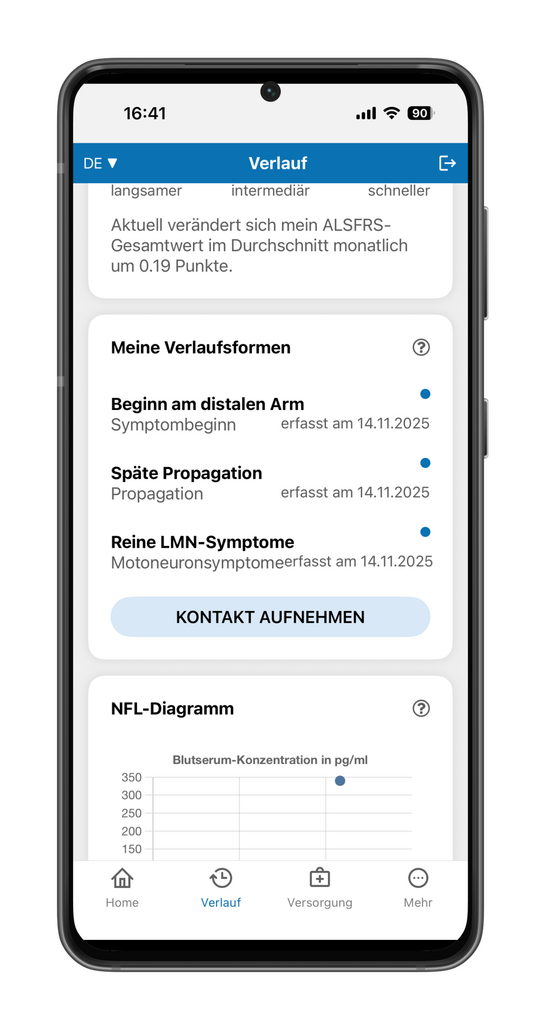
My progression forms
The OPM classification with the locationof symptom onset, propagation(spread) and extent of motor neuron symptomsis displayed in the “My progressions” section.
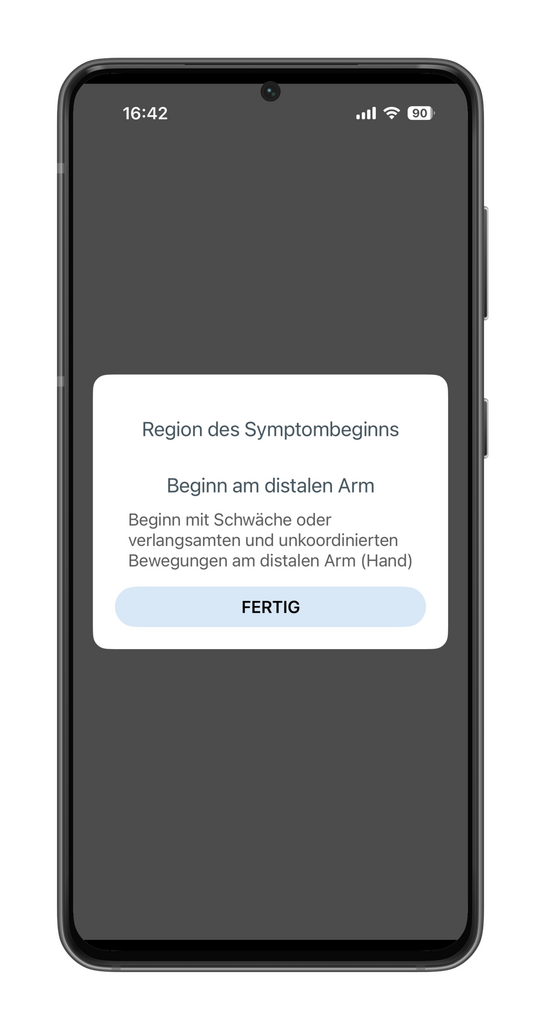
Contact for questions about the progression form
If you have any questions about the progression form or the OPM classification, you can call us via the Contact page or send us an e-mail.
The OPM classification in the ALS app
The OPM classification with the location of the symptom onset, the propagation (spread) and the extent of the motor neuron symptoms is displayed in the “My progressions” section of the ALS app.
The data on OPM classification has so far been transferred to the ALS app from the studies “NfL (Neurofilament light chain) in ALS” and “id-ALS – Identification of genetic changes in people with ALS”.