



The function can be used by patients participating in the Nf-L ALS study and Ambulanzpartner simultaneously. Parallel participation in Outpatient Partners is necessary for the notification of results, as the ALS app is not a formal part of the “Nf-L in ALS” study.
How are the Nf-L analysis results presented?
The Nf-L analysis results are displayed in a diagram in the APST portal and in the ALS app. In the ALS app, the Nf-L diagram can be found on the “History” page, below the ALSFRS history diagram. The Nf-L analysis is not carried out continuously as in a “routine laboratory”, but as part of a scientific project. For this purpose, samples from different ALS centres are collected (“pooling”) and thus analysed with a delay. Once the analysis and data processing have been completed, the data for those patients for whom a declaration of consent for outpatient partners is available is displayed in the ALS app.
What should I bear in mind when reporting NF-L results?
For patients participating in the ALS-Nf-L study, expert medical interpretation of the findings is essential due to the open research questions. Various medical factors must be considered. The Nf-L value is therefore assessed in personal doctor-patient contact at a Nf-L study centre.
Nf-L progression diagram
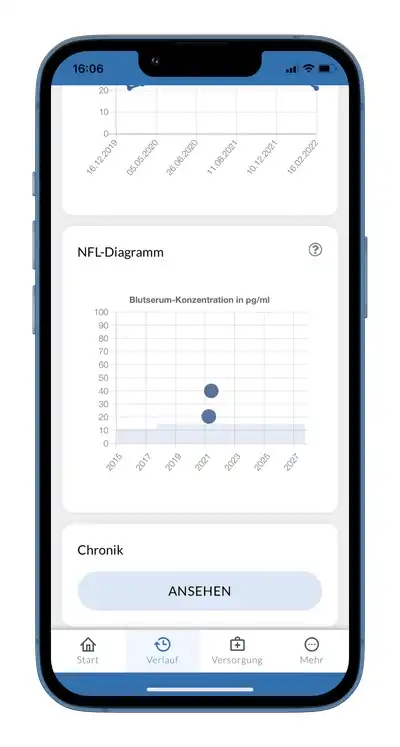
Nf-L diagram
The Nf-L diagram in the ALS app. The normal range of Nf-L serum concentrations is shown in colour (light blue). The steps in the normal range result from the age-dependent increase in Nf-L serum concentrations. The level of the Nf-L serum concentration (in picograms per milliliter, pg/mL) can be read off the left-hand scale.
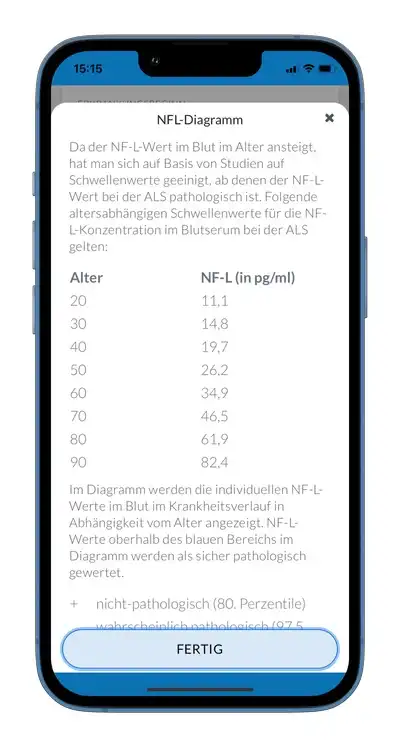
Age-dependent normal range
Nf-L can also be detected at lower concentrations in healthy people. However, the Nf-L value increases with age, even in healthy individuals. The normal range of Nf-L serum concentrations is described in the info text behind the ?-symbol.