



Self-assessment of disease progression: the ALS functional scale
The ALS functional scale (Amyotrophic Lateral Sclerosis Functional Rating Scale revised (ALSFRSr) scale) is a questionnaire that enables people with ALS to record and evaluate the progression of their disease.
How the ALS function scale works
The ALSFRSr questionnaire consists of twelve questions, each with five sub-questions, the answers to which are rated on a point scale from 0 to 4. This results in a total score of between 48 and 0 points, which can be used to record the status of the disease and assess its progression (rapid, average, slow).
ALS app: ALS function scale
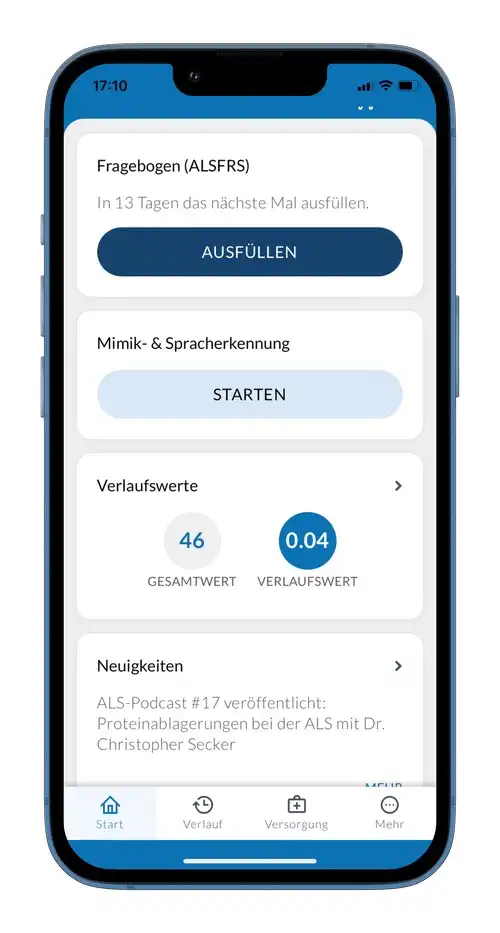
Open ALS self-assessment questionnaire
You can access the ALS self-assessment questionnaire (ALSFRS questionnaire) via the “Complete” button on the start page. The questionnaire should be completed every 2 weeks. The days until the next response are counted down and displayed.
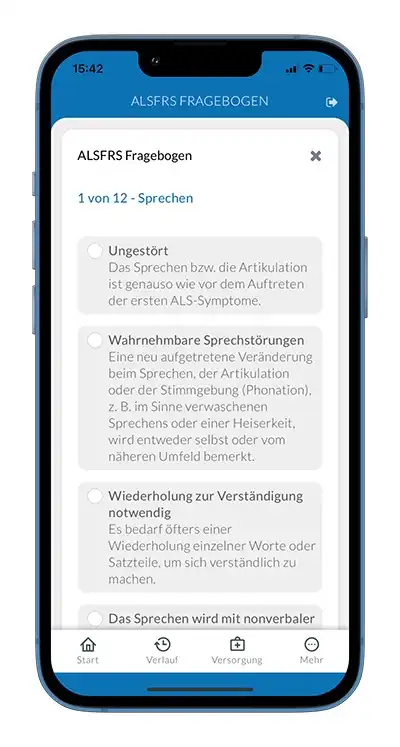
The ALS self-assessment questionnaire (ALSFRS questionnaire)
The ALSFRS questionnaire consists of twelve questions on the functions of the head, arms, legs, trunk and breathing. The five possible answers per question are rated on a point scale from 0 to 4. Each answer option is briefly explained.
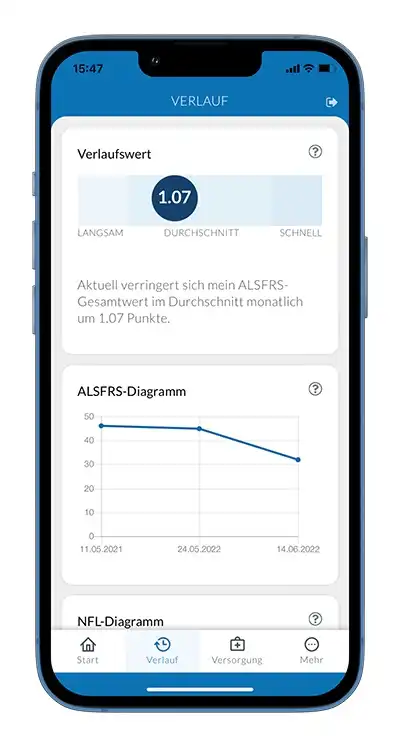
Result with total value and progression value
After answering all 12 questions of the ALSFRS questionnaire, the total score is between 48 and 0 points. The total score of the ALS functional scale and the progression score are displayed after completing the questionnaire. The progression score can only be calculated if the date of onset of the disease has been entered beforehand.
Presentation of the course of the disease and progression value
On the ‘Progression’ page you will find a diagram showing the values of the ALS functional scale over time. The diagram shows a standardized representation of the course of the disease. This makes the development of the disease visible and understandable for patients.
What is the progression value?
The progression value in the ALS app offers the option of classifying the speed of the disease progression as fast, slow or average. It serves as a guide for those affected as well as for doctors and therapists treating them. The progression calculator calculates a progression value from the current ALSFRS total value and the date of onset of the disease. If the progression calculator indicates a progression value between 0.5 and 2.0, this is referred to as an average disease progression. A progression value of less than 0.5 describes a slow disease progression and all values above 2.0 are faster disease progression.
ALS app: ALSFRS progression chart and progression value
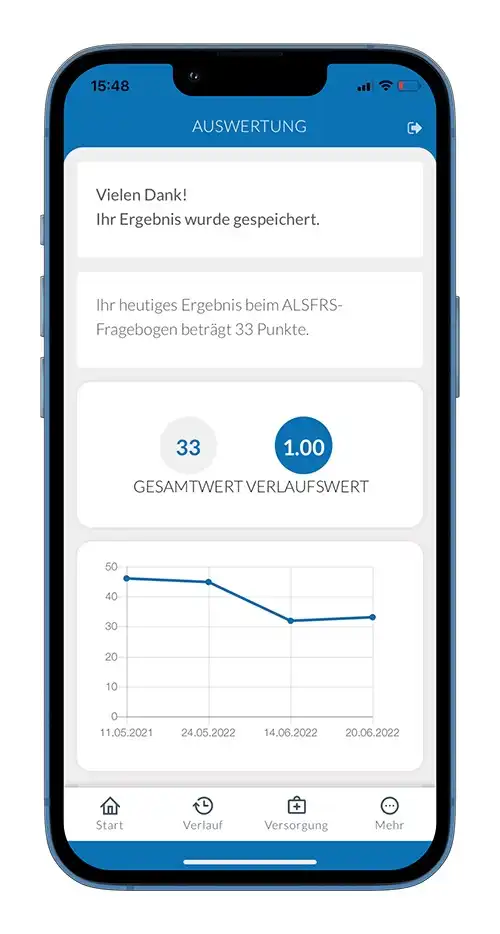
Progression value and ALSFRS diagram
On the “Progression” page, the values of the ALS functional scale are displayed in a progression diagram. The diagram provides a good understanding of the progression of the disease. The current progression value is shown in a diagram as fast, slow or average.
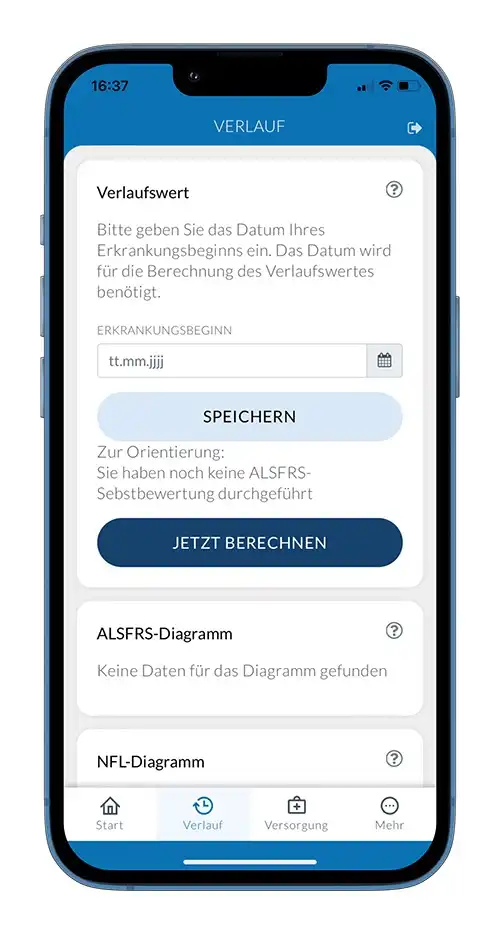
Calculation of the progression value
The data for calculating the progression value is not recorded automatically, but must be entered by the user. The date of onset of the disease and a current value of the ALSFRS function scale are required to calculate the progression value.
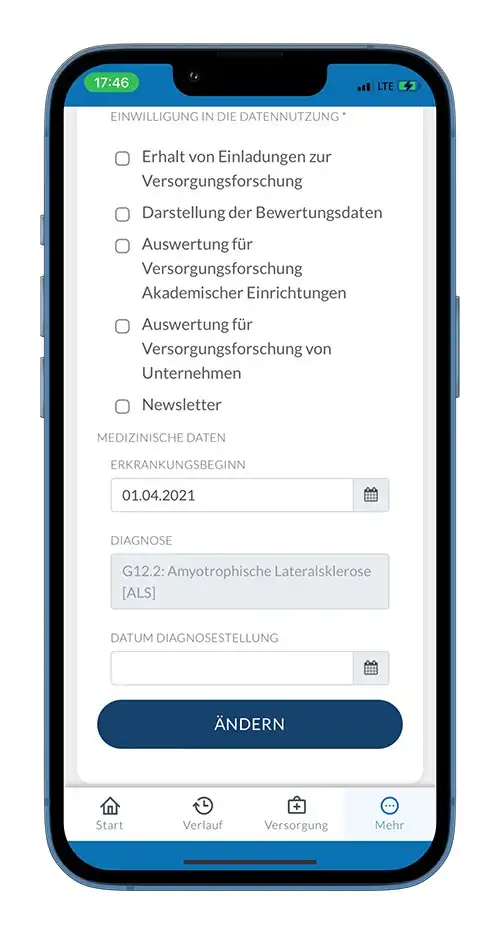
Dates for onset of illness and diagnosis
Your main diagnosis and the dates of onset and diagnosis are documented on the “Personal data” page. This data is important for calculating the progression value, displaying the course of the disease (ALSFRS diagram) and determining the phases of the disease (King’s phases) in the chronicle.